Programmatic Agreement
Between the Federal Highway Administration, New Hampshire Division and the New Hampshire Department of Transportation Regarding the Processing of Actions Classified as Categorical Exclusions for Federal Aid Highway Projects
This Programmatic Agreement (“Agreement”), made and entered into this 28th day of April 2026, by and between the Federal Highway Administration, United States Department of Transportation and the State of New Hampshire, acting by and through its Department of Transportation hereby provides as follows:
Witnesseth:
Whereas, the National Environmental Policy Act of 1969 (NEPA), 42 United States Code (USC) §§ 4321-4370h (2014), directs Federal agencies to consider the environmental impacts of their proposed major Federal actions through the preparation of an environmental assessment (EA) or environmental impact statement (EIS) unless a particular action is categorically excluded from those requirements; and
Whereas, the Federal Highway Administration’s (FHWA) distribution and spending of Federal funds under the Federal-aid Highway Program and approval of actions pursuant to Title 23 of the United States (US) Code are major Federal actions subject to the National Environmental Policy Act (NEPA); and
Whereas, the US Secretary of Transportation has delegated to FHWA the authority to carry out functions of the Secretary under NEPA as they relate to matters within FHWA’s primary responsibilities (49 CFR 1.81(a)(5)); and
Whereas, the FHWA’s NEPA implementing procedures (23 CFR part 771) list a number of categorical exclusions (CEs) for certain actions that FHWA has determined do not individually or cumulatively have a significant effect on the human environment and therefore do not require the preparation of an EA or EIS (23 CFR 771.117(c)-(d)); and
Whereas, the New Hampshire Department of Transportation (NHDOT) is a state agency that undertakes transportation projects using Federal funding received under the Federal-aid Highway Program and assists FHWA in fulfilling its obligations under NEPA for NHDOT projects (23 CFR 771.109); and
Whereas, Section 1318(d) of the Moving Ahead for Progress in the 21st Century Act (MAP-21), Pub. L. 112-141, 126 Stat. 405 (July 6, 2012), allows FHWA to enter into programmatic agreements with the states that establish efficient administrative procedures for carrying out environmental and other required project reviews, including agreements that allow a state to determine whether a project qualifies for a CE on behalf of FHWA; and
Whereas, FHWA developed regulations implementing the authorities in section 1318(d), effective November 6, 2014 (23 CFR 771.117(g)); and
Whereas, FHWA and NHDOT have designated additional CEs for the State of New Hampshire and identified them in this Agreement pursuant to section 1315 of the Fixing America’s Surface Transportation (FAST) Act, Pub. L. 114-94, 129 Stat. 1312 (Dec. 4, 2015), and 23 CFR 771.117(g);
Now therefore, FHWA and NHDOT enter into this Programmatic Agreement (“Agreement”) for the processing of CEs.
-
Parties
The Parties to this Agreement are the Federal Highway Administration ( “FHWA”) and the New Hampshire Department of Transportation ( “NHDOT”).
-
Purpose
The purpose of this Agreement is to authorize NHDOT to determine on behalf of FHWA whether a project qualifies for a CE action specifically listed in 23 CFR 771.117 (listed in Appendix A of this Agreement) or a CE designated for the State of New Hampshire (listed in Appendix B of this Agreement). This Agreement also authorizes NHDOT to certify to FHWA that an action it cannot approve on behalf of FHWA according to the terms of this Agreement, but meeting the CE criteria in 23 CFR 771.117(a), qualifies for a CE as long as there are no unusual circumstances present that would require the preparation of either an EA, or an EIS.
-
Authorities
This Agreement is entered into pursuant to the following authorities:
-
National Environmental Policy Act, 42 U.S.C. § 4321 et seq.
-
Moving Ahead for Progress in the 21st Century Act, Pub. L. 112-141, 126 Stat. 405, Sec. 1318(d) (July 6, 2012)
-
Fixing America’s Surface Transportation (FAST) Act, Pub. L. 114-94, 129 Stat. 1312, Sec. 1315 (December 4, 2015)
-
Infrastructure Investment and Jobs Act, Pub. L. 117-58, 135 Stat. 429 (November 15, 2021)
-
US Department of Transportation (DOT) Order 5610.1C
-
23 CFR 771.117
-
Responsibilities
-
The NHDOT is responsible for:
-
Ensuring the following process is completed for each project that qualifies for a CE:
-
For actions qualifying for a CE listed in Appendix A (CEs established in 23 CFR 771.117(c) and 23 CFR 771.117(d)), and designated CE actions in Appendix B, that do not exceed the thresholds in Section IV(A)(1)(b) below, the NHDOT may make a CE approval on behalf of FHWA. The NHDOT will identify the applicable CE from Appendix A or B, ensure any conditions or constraints are met, verify that unusual circumstances do not apply, address any and all other environmental requirements, and complete the review with a signature evidencing approval. No separate review or approval of the CE by FHWA is required.
-
Actions listed in Appendices A and B that exceed any of the thresholds below may not be approved by the NHDOT. In these cases, NHDOT will certify to FHWA that the action qualifies for a CE. An action requires FHWA CE review and approval based on NHDOT’s certification if the action:
-
Involves any residential or non-residential displacements, or acquisition of property rights to an extent that impairs the functions of the affected property (defined as a minor amount of right-of-way);
-
Results in capacity expansion of a roadway by addition of through lanes;
-
Involves the construction of temporary access, or the closure of existing road, bridge, or ramps, that would result in major traffic disruptions. Major traffic disruption is defined as a case-by-case scenario, when the NHDOT, in consultation with FHWA, agrees that the project scope will interrupt traffic patterns beyond normal project conditions;
-
Involves changes in access control that pertain to interstates, or where NHDOT concludes that an access modification may have wide-reaching ramifications;
-
Uses CE Action Number 26, 27, or 28 and results in a determination of adverse effect on historic properties pursuant to Section 106 the National Historic Preservation Act;
-
Requires the use of properties protected by Section 4(f) of the Department of Transportation Act (49 USC § 303/23 USC § 138) that cannot be documented with a FHWA de minimis determination, or a programmatic Section 4(f) evaluation, other than the programmatic evaluation for the use of historic bridges;
-
Requires the acquisition of lands under the protection of Section 6(f) of the Land and Water Conservation Act of 1965 (54 USC § 200305), or other unique areas or special lands that were acquired in fee or easement with public-use money and have deed restrictions or covenants on the property;
-
Requires a US Army Corps of Engineers Section 404 (33 USC § 1344) permit other than a Nationwide Permit or a General Permit;
-
Requires a US Coast Guard bridge permit (33 USC § 401);
-
Requires work encroaching on a regulatory floodway, or requires work affecting the base floodplain (100-year flood) elevation of a watercourse or lake, pursuant to Executive Order 11988 and 23 CFR § 650 subpart A, in such a way that results in a more than nominal increase in base flood elevations;
-
Uses CE Action Number 26, 27, or 28 and requires any work below the ordinary high water mark of:
-
A river designated as a component of, or proposed for inclusion in, the National System of Wild and Scenic Rivers published by the US Department of the Interior/US Department of Agriculture; or
-
A tributary of a river designated as a component of, or proposed for inclusion in, the National System of Wild and Scenic Rivers published by the US Department of the Interior/US Department of Agriculture.
-
Is defined as a “Type I project” per 23 CFR 772.5 and the NHDOT Policy for the Assessment and Abatement of Highway Traffic Noise for Type I & Type II Highway Projects;
-
May affect, likely to adversely affect, federally listed or candidate species, or proposed or designated critical habitat of species protected by the Endangered Species Act, and is not included in an approved Biological Opinion;
-
Results in impacts subject to the conditions of the Bald and Golden Eagle Protection Act that require an eagle incidental take permit;
-
Includes acquisition of land for hardship or protective purposes, or early acquisition pursuant to a Federal acquisition project (23 USC § 108(d));
-
Does not conform to the State Implementation Plan which is approved or promulgated by the US Environmental Protection Agency (EPA) in air quality non- attainment areas;
-
Is not included in, or is inconsistent with, the statewide transportation improvement program, and in applicable urbanized areas, the transportation improvement program;
-
Causes or contributes to violations of the National Ambient Air Quality Standards (NAAQS); or
-
Is not consistent with the State’s Coastal Zone Management Plan.
-
The NHDOT may not approve actions not specifically listed as CEs in Appendices A and B. Instead, if NHDOT believes that an action meets the requirements of a CE under 23 CFR 771.117(a), NHDOT may certify to FHWA, in accordance with Section IV (A)(1)(c)(i), that an action will not result in significant environmental impacts, and that the action qualifies for a CE and does not involve unusual circumstances that warrant the preparation of an EA or EIS. The FHWA shall either agree in writing that the action qualifies for a CE or direct NHDOT to prepare an EA or EIS.
-
The NHDOT shall prepare an individual CE for FHWA approval unless otherwise directed by FHWA.
-
If any project requires a Section 4(f) determination, the NHDOT shall submit the 4(f) documentation for FHWA determination and approval.
-
The FHWA Division Office’s objection to a NHDOT CE certification may not constitute a disapproval of the action but signifies that FHWA will need to engage in project-specific review to verify that the certification is adequate, which may include consultation with other agencies.
-
Providing a list of certified actions pursuant to this Agreement to the FHWA Division Office on a quarterly basis. The list of certified actions will contain the following information:
-
The NHDOT project name and number;
-
Identification of the CE action listed in Appendix A, or if the action is not listed in 23 CFR 771.117, identification of the action as “CE not categorized;”
-
Whether the project included a Section 4(f) de minimis evaluation, or a programmatic Section 4(f) evaluation; and
-
The NEPA start date and NEPA completion date.
-
Consulting with FHWA for actions that involve unusual circumstances (23 CFR 771.117(b)), to determine the appropriate class of action for environmental analysis and documentation. The NHDOT may decide, or FHWA may require additional studies to be performed prior to making a CE approval, or the preparation of an EA or EIS.
-
Meeting applicable documentation requirements in Section V for State CE approvals on FHWA's behalf and State CE certifications to FHWA, applicable approval and re-evaluation requirements in Section VI, and applicable quality control/quality assurance, monitoring, and performance requirements in Section VII.
-
Relying only upon employees directly employed by the State to make CE approvals or certifications submitted to FHWA under this Agreement as stated in Section VI. The NHDOT may not delegate its responsibility for CE approvals or certifications to third parties (i.e., consultants, local government staff, and other State agency staff).
-
The FHWA is responsible for:
-
Providing timely advice and technical assistance on CEs to the NHDOT, as requested.
-
Providing timely input and review of certified actions. FHWA will base its approval of CE actions on the project documentation and certifications prepared by NHDOT under this Agreement.
-
Overseeing the implementation of this Agreement in accordance with the provisions in Section VII, including applicable monitoring and performance provisions.
-
Documentation of NHDOT CE Approvals
-
For State CE approvals and State CE certifications to FHWA for approval, NHDOT shall prepare documentation included in Appendix D, identifying the applicable action, ensuring any conditions specified in FHWA regulation are met, verifying that unusual circumstances do not apply, addressing all other environmental requirements, and completing the review with a NHDOT signature evidencing approval.
-
The NHDOT shall maintain a project record of CE approvals it makes on FHWA's behalf, and each CE submitted to FHWA for approval. This record should include at a minimum:
-
Any checklists, forms, or other documents and exhibits that summarize the consideration of project effects and unusual circumstances;
-
A summary of public involvement complying with the requirements of NHDOT manual Env 1, Manual 2: NEPA Public Involvement Manual (the FHWA-approved public involvement policy);
-
Any stakeholder communication, correspondence, consultation, or public meeting documentation;
-
The name and title of the document approver and the date of NHDOT’s approval or FHWA’s final approval; and
-
For cases involving re-evaluations, any documented re-evaluation (when required) or a statement that a re-evaluation was completed for the project (when documentation is not necessary).
-
The NHDOT shall provide any electronic or paper project records it maintains to FHWA at its request. The NHDOT should retain those records, including all letters and comments received from governmental agencies, the public, and others for a period of no less than three (3) years after completion of project construction. This 3-year retention provision does not relieve NHDOT of its project or program recordkeeping responsibilities under 2 CFR 200.334-200.338 or any other applicable laws, regulations, or policies.
-
NEPA Approvals and Re-Evaluations
-
The NHDOT’s CE approvals, and certification of CEs submitted to FHWA for approval, may only be made by officers or offices specifically identified below:
-
The Administrator of the Bureau of Environment.
-
A Bureau of Environment Section Chief, in the absence of the Bureau of Environment Administrator.
-
The Director of Project Development, in the absence of the Bureau of Environment Administrator and the Bureau of Environment Section Chiefs.
-
Any Department of Transportation Commissioner.
-
In accordance with 23 CFR 771.129, NHDOT shall re-evaluate its determinations and certifications for projects, consult with FHWA, and as necessary, prepare additional documentation to ensure that determinations are still valid.
-
Quality Control/Quality Assurance, Monitoring and Performance
-
NHDOT Quality Control & Quality Assurance/Monitoring and Performance
-
The NHDOT shall carry out regular quality control and quality assurance activities to ensure that its CE approvals, and CE submissions to FHWA for approval, are made in accordance with applicable law and this Agreement.
-
The FHWA and NHDOT shall cooperate in monitoring performance under this Agreement and work to assure quality performance.
-
FHWA Oversight and Monitoring
-
Monitoring by FHWA will include consideration of the technical competency and organizational capacity of NHDOT, as well as NHDOT’s performance of its CE processing functions. Performance considerations include, without limitation, the quality and consistency of NHDOT’s CE approvals, CE submissions to FHWA for approval, adequacy and capability of NHDOT staff, and the effectiveness of NHDOT’s administration of its internal CE approvals.
-
FHWA will conduct one or more program reviews as part of its oversight activities during the term of this Agreement. The NHDOT shall prepare and implement a corrective action plan to address any findings or observations identified in the FHWA review. The NHDOT should draft the corrective action plan within 45 days of FHWA finalizing its review. The results of that review and corrective actions taken by the NHDOT shall be considered at the time this Agreement is considered for renewal.
-
Nothing in this Agreement prevents FHWA from undertaking other monitoring or oversight actions, including audits, with respect to NHDOT’s performance under this Agreement. The FHWA may require NHDOT to perform such other quality assurance activities, including other types of monitoring, as may be reasonably required to ensure compliance with applicable Federal laws and regulations.
-
The NHDOT agrees to cooperate with FHWA in all oversight and quality assurance activities.
-
Amendments
If the parties agree to amend this Agreement, then FHWA and NHDOT may execute an amendment with new signatures and dates of the signatures. The term of the Agreement shall remain unchanged unless otherwise expressly stated in the amended Agreement.
-
Term, Renewal and Termination
-
This Agreement shall have a term of five (5) years, effective on the date of the last signature. The NHDOT shall post and maintain an executed copy of this Agreement on its website, available to the public.
-
This Agreement is renewable for additional five (5) year terms if NHDOT requests renewal and FHWA determines that NHDOT has satisfactorily carried out the provisions of this Agreement. In considering any renewal of this Agreement, FHWA will evaluate the effectiveness of the Agreement and its overall impact on the environmental review process.
-
Either party may terminate this Agreement at any time only by giving at least 30 days written notice to the other party.
-
Expiration or termination of this Agreement shall mean that the NHDOT is not able to make CE approvals on FHWA’s behalf.
Execution of this Agreement and implementation of its terms by both parties provides evidence that both parties have reviewed this Agreement and agree to the terms and conditions for its implementation.
-
Effective Date
This Agreement shall become effective upon the date of the last signature below. After that date, all Programmatic CEs processed by NHDOT shall utilize the National Environmental Policy Act Categorical Exclusion Determination Form in Appendix D. Any Programmatic CEs not yet submitted, or that were previously submitted to NHDOT for approval, but that have not been fully executed prior to this date, shall be required to use the National Environmental Policy Act Categorical Exclusion Determination Form in Appendix D.
-
Signatures
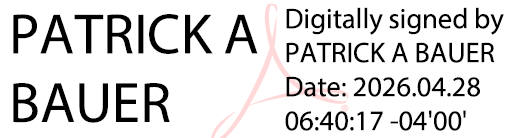
Patrick A. Bauer
Division Administrator
Federal Highway Administration
NH Division Office
Date: 4-28-2026

David Rodrigue
Commissioner
NH Department of Transportation
Date: 4/21/2026
Appendix A: 23 CFR 771.117 FHWA Categorical Exclusions
Appendix B: Categorical Exclusions Designated in New Hampshire
Appendix C: Links to Referenced Regulations and Other Documents
Appendix D: Template NEPA Categorical Exclusion Determination Form
Appendix A
23 CFR 771.117 FHWA Categorical Exclusions
-
(a) CEs are actions that, based on FHWA’s past experience with similar actions, normally do not involve significant environmental impacts. They are actions that: Do not include significant impacts to planned growth or land use for the area; do not require the relocation of significant numbers of people; do not have significant impact on any natural, cultural, recreational, historic or other resource; do not involve significant air, noise, or water quality impacts; do not have significant impacts on travel patterns; or do not otherwise have any significant environmental impacts.
-
(b) Any action that normally would be classified as a CE but could involve unusual circumstances will require the FHWA, in cooperation with the applicant, to conduct appropriate environmental studies to determine if the CE classification is proper. Such unusual circumstances include:
-
(1) Significant environmental impacts;
-
(2) Substantial controversy on environmental grounds;
-
(3) Significant impact on properties protected by Section 4(f) requirements or Section 106 of the National Historic Preservation Act; or
-
(4) Inconsistencies with any Federal, State, or local law, requirement or administrative determination relating to the environmental aspects of the action.
-
(c) The following actions meet the criteria for CEs in paragraph (a) of this section and normally do not require any further NEPA approvals by the FHWA:
-
(1) Activities that do not involve or lead directly to construction, such as planning and research activities; grants for training; engineering to define the elements of a proposed action or alternatives so social, economic, and environmental effects can be assessed; and Federal-aid system revisions establishing classes of highways on the Federal-aid highway system.
-
(2) Approval of utility installations along or across a transportation facility.
-
(3) Construction of bicycle and pedestrian lanes, paths, and facilities.
-
(4) Activities included in the State's highway safety plan under 23 U.S.C. 402.
-
(5) Transfer of Federal lands pursuant to 23 U.S.C. 107(d) and/or 23 U.S.C. 317 when the land transfer is in support of an action not otherwise subject to FHWA review under NEPA.
-
(6) The installation of noise barriers or alterations to existing publicly owned buildings to provide for noise reduction.
-
(7) Landscaping.
-
(8) Installation of fencing, signs, pavement markings, small passenger shelters, traffic signals, and railroad warning devices where no substantial land acquisition or traffic disruption will occur.
-
(9) The following actions for transportation facilities damaged by an incident resulting in an emergency declared by the Governor of the State and concurred in by the Secretary, or a disaster or emergency declared by the President pursuant to the Robert T. Stafford Act (42 U.S.C. 5121):
-
(i) Emergency repairs under 23 U.S.C. 125; and
-
(ii) The repair, reconstruction, restoration, retrofitting, or replacement of any road, highway, bridge, tunnel, or transit facility (such as a ferry dock or bus transfer station), including ancillary transportation facilities (such as pedestrian/bicycle paths and bike lanes), in operation or under construction when damaged and the action:
-
(A) Occurs within the existing right-of-way and in a manner that substantially conforms to the preexisting design, function, and location as the original (which may include upgrades to meet existing codes and standards as well as upgrades warranted to address conditions that have changed since the original construction); and
-
(B) Is commenced within a 2-year period beginning on the date of the declaration.
-
(10) Acquisition of scenic easements.
-
(11) Determination of payback under 23 U.S.C. 156 for property previously acquired with Federal-aid participation.
-
(12) Improvements to existing rest areas and truck weigh stations.
-
(13) Ridesharing activities.
-
(14) Bus and rail car rehabilitation.
-
(15) Alterations to facilities or vehicles in order to make them accessible for elderly and handicapped persons.
-
(16) Program administration, technical assistance activities, and operating assistance to transit authorities to continue existing service or increase service to meet routine changes in demand.
-
(17) The purchase of vehicles by the applicant where the use of these vehicles can be accommodated by existing facilities or by new facilities that themselves are within a CE.
-
(18) Track and railbed maintenance and improvements when carried out within the existing right-of-way.
-
(19) Purchase and installation of operating or maintenance equipment to be located within the transit facility and with no significant impacts off the site.
-
(20) Promulgation of rules, regulations, and directives.
-
(21) Deployment of electronics, photonics, communications, or information processing used singly or in combination, or as components of a fully integrated system, to improve the efficiency or safety of a surface transportation system or to enhance security or passenger convenience. Examples include, but are not limited to, traffic control and detector devices, lane management systems, electronic payment equipment, automatic vehicle locaters, automated passenger counters, computer-aided dispatching systems, radio communications systems, dynamic message signs, and security equipment including surveillance and detection cameras on roadways and in transit facilities and on buses.
-
(22) Projects, as defined in 23 U.S.C. 101, that would take place entirely within the existing operational right-of-way. Existing operational right-of-way means all real property interests acquired for the construction, operation, or mitigation of a project. This area includes the features associated with the physical footprint of the project including but not limited to the roadway, bridge, interchanges, culverts, drainage, clear zone, traffic control signage, landscaping, and any rest areas with direct access to a controlled access highway. This also includes fixed guideways, mitigation areas, areas maintained or used for safety and security of a transportation facility, parking facilities with direct access to an existing transportation facility, transportation power substations, transportation venting structures, and transportation maintenance facilities.
-
(23) Federally-funded projects:
-
(i) Receiving less than $6,000,000 (as adjusted annually by the Secretary to reflect any increases in the Consumer Price Index prepared by the Department of Labor, see www.fhwa.dot.gov or www.transit.dot.gov) of Federal funds; or
-
(ii) With a total estimated cost of not more than $35,000,000 (as adjusted annually by the Secretary to reflect any increases in the Consumer Price Index prepared by the Department of Labor, see www.fhwa.dot.gov or www.fta.dot.gov) and Federal funds comprising less than 15 percent of the total estimated project cost.
-
(24) Localized geotechnical and other investigation to provide information for preliminary design and for environmental analyses and permitting purposes, such as drilling test bores for soil sampling; archeological investigations for archeology resources assessment or similar survey; and wetland surveys.
-
(25) Environmental restoration and pollution abatement actions to minimize or mitigate the impacts of any existing transportation facility (including retrofitting and construction of stormwater treatment systems to meet Federal and State requirements under sections 401 and 402 of the Federal Water Pollution Control Act (33 U.S.C. 1341; 1342)) carried out to address water pollution or environmental degradation.
-
(26) Modernization of a highway by resurfacing, restoration, rehabilitation, reconstruction, adding shoulders, or adding auxiliary lanes (including parking, weaving, turning, and climbing lanes), if the actions meet the constraints in paragraph (e) of this section.
-
(27) Highway safety or traffic operations improvement projects, including the installation of ramp metering control devices and lighting, if the project meets the constraints in paragraph (e) of this section.
-
(28) Bridge rehabilitation, reconstruction, or replacement or the construction of grade separation to replace existing at grade railroad crossings, if the actions meet the constraints in paragraph (e) of this section.
-
(29) Purchase, construction, replacement, or rehabilitation of ferry vessels (including improvements to ferry vessel safety, navigation, and security systems) not requiring a change in the function of the ferry terminals and can be accommodated by existing facilities or by new facilities which themselves are within a CE.
-
(30) Rehabilitation or reconstruction of existing ferry facilities that occupy substantially the same geographic footprint, do not result in a change in their functional use, and do not result in a substantial increase in the existing facility's capacity. Example actions include work on pedestrian and vehicle transfer structures and associated utilities, buildings, and terminals.
-
(d) Additional actions that meet the criteria for a CE in paragraph (a) of this section may be designated as CEs only after Administration approval unless otherwise authorized under an executed agreement pursuant to paragraph (g) of this section. The applicant must submit documentation that demonstrates that the specific conditions or criteria for these CEs are satisfied, and that significant environmental effects will not result. Examples of such actions include but are not limited to:
-
(1)-(3) [Reserved]
-
(4) Transportation corridor fringe parking facilities.
-
(5) Construction of new truck weigh stations or rest areas.
-
(6) Approvals for disposal of excess right-of-way or for joint or limited use of right-of-way, where the proposed use does not have significant adverse impacts.
-
(7) Approvals for changes in access control.
-
(8) Construction of new bus storage and maintenance facilities in areas used predominantly for industrial or transportation purposes where such construction is not inconsistent with existing zoning and located on or near a street with adequate capacity to handle anticipated bus and support vehicle traffic.
-
(9) Rehabilitation or reconstruction of existing rail and bus buildings and ancillary facilities where only minor amounts of additional land are required, and there is not a substantial increase in the number of users.
-
(10) Construction of bus transfer facilities (an open area consisting of passenger shelters, boarding areas, kiosks and related street improvements) when located in a commercial area or other high activity center in which there is adequate street capacity for projected bus traffic.
-
(11) Construction of rail storage and maintenance facilities in areas used predominantly for industrial or transportation purposes where such construction is not inconsistent with existing zoning, and where there is no significant noise impact on the surrounding community.
-
(12) Acquisition for hardship or protective purposes. Hardship and protective buying will be permitted only for a particular parcel or a limited number of parcels. These types of land acquisition qualify for a CE only where the acquisition will not limit the evaluation of alternatives, including shifts in alignment for planned construction projects, which may be required in the NEPA process. No project development on such land may proceed until the NEPA process has been completed.
-
(13) Actions described in paragraphs (c)(26), (c)(27), and (c)(28) of this section that do not meet the constraints in paragraph (e) of this section.
-
(e) Actions described in (c)(26), (c)(27), and (c)(28) of this section may not be processed as CEs under paragraph (c) if they involve:
-
(1) An acquisition of more than a minor amount of right-of-way or would result in any residential or non-residential displacements;
-
(2) An action that needs a bridge permit from the U.S. Coast Guard, or an action that does not meet the terms and conditions of a U.S. Army Corps of Engineers nationwide or general permit under section 404 of the Clean Water Act and/or section 10 of the Rivers and Harbors Ac of 1899;
-
(3) A finding of “adverse effect” to historic properties under the National Historic Preservation Act, the use of a resource protected under 23 U.S.C. 138 or 49 U.S.C. 303 (section 4(f)) except for actions resulting in de minimis impacts, or a finding of “may affect, likely to adversely affect” threatened or endangered species or critical habitat under the Endangered Species Act;
-
(4) Construction of temporary access or the closure of existing road, bridge, or ramps that would result in major traffic disruptions;
-
(5) Changes in access control;
-
(6) A floodplain encroachment other than functionally dependent uses (e.g., bridges, wetlands) or actions facilitating open space use (e.g., recreational trails, bicycle and pedestrian paths); or construction activities in, across or adjacent to a river component designated or proposed for inclusion in the National System of Wild and Scenic River.
Appendix B
Categorical Exclusions Designated in New Hampshire
The NHDOT and FHWA agree on the following categorical exclusions pursuant to section 1315 of the Fixing America’s Surface Transportation (FAST) Act, Pub. L. 114-94, 129 Stat. 1312 (Dec. 4, 2015), 40 CFR 1508.4 and 23 CFR 771.117(g):
-
Installation, modification, operation, and removal of electric vehicle charging stations, using commercially available technology, within a previously disturbed or developed area.
-
Projects designed to reduce wildlife mortality along roadways, including actions that upsize crossings, retrofit crossings for wildlife passage, replace culverts with bridges, and install measures to deter wildlife from utilizing roadways and rights-of-way for reproductive purposes, grazing and foraging.
-
Culvert installation, replacement and rehabilitation.
-
Projects to reuse/waste excess soils excavated from within the state right-of-way.
-
Projects for protective management of media impacted by per- and polyfluoroalkyl substances, and other contaminated materials.
Appendix C
Links to Referenced Regulations and Other Relevant Documents
Federal Resources
- National Environmental Policy Act of 1969, 42 U.S.C. §§ 4321-4370h (2014)
- Delegation to all Administrators (49 CFR 1.81)
- 23 CFR part 771 (Environmental Impact and Related Procedures)
- Moving Ahead for Progress in the 21st Century Act (MAP-21), Pub. L. 112-141
- Fixing America’s Surface Transportation (FAST) Act, Pub. L. 114-94, 129 Stat. 1312 (Dec. 4, 2015)
- DOT Order 5610.1C (Procedures for Considering Environmental Impacts)
- Section 4(f) of the Department of Transportation Act
- 49 U.S.C. § 303
- 23 U.S.C. § 138
- Section 6(f) of the Land and Water Conservation Act of 1965 (54 U.S.C. § 200305)
- US Army Corps of Engineers Section New England District Office
- Permits for Dredged or Fill Material (33 U.S.C. § 1344)
- US Coast Guard bridge permit (33 U.S.C. § 401)
- Executive Order 11988 – Floodplain Management
- Location and Hydraulic Design of Encroachment on Flood Plains (23 CFR § 650 subpart A)
- Procedures for the Abatement of Highway Traffic Noise and Construction Noise (23 CFR part 772)
- The Endangered Species Act, Pub. L. 93-205
- Bald and Golden Eagle Protection Act (16 U.S.C. § 668)
- Advance acquisition of real property (23 U.S.C. § 108(d))
- National Ambient Air Quality Standards (NAAQS)
State-specific Resources
- National System of Wild and Scenic Rivers
- NHDOT Air & Noise Program
- NHDOT Noise Policy
- NH Statewide Transportation Improvement Program
- New Hampshire Coastal Zone Management
Appendix D
Template Categorical Exclusion Determination Form

State of New Hampshire Department of Transportation
National Environmental Policy Act Categorical Exclusion Determination Form
Action/Project Name: Click to enter Project Name.
Federal Project Number: Click to enter Federal Number.
State Project Number: Click to enter State Number.
National Environmental Policy Act (NEPA) Start Date: Click to select a date.
Categorical Exclusion (CE) Action Number (See Section XI): Choose CE Action Number.
Section I: Project Description
(Briefly summarize the scope of the selected alternative/proposed action to include the location, beginning and end points, and relevant design aspects. Attach additional sheets, as necessary.)
Click to enter Project Description.
Section II: Classification Determination
(Select the appropriate classification below)
Choose the appropriate NEPA classification.
Signatures
| Prepared by: |
Click here to sign or delete and sign in ink.
Click to enter Preparer Name.
Click to enter Prepare Title. |
Click to enter date. |
| Approval Recommended by: |
Click here to sign or delete and sign in ink.
Click to enter Recommender Name.
Click to enter Recommender Title. |
Click to enter date. |
| Approved by: |
Click here to sign or delete and sign in ink.
Click to enter Approver Name.
Click to enter Approver Title. |
Click to enter date. |
Section Ill: Executive Orders and Section 4(f)
(Check all that apply below)
Executive Order 11988 – Floodplains
▢ The proposed action includes construction in floodplains. Pursuant to Executive Order 11988, this project includes the use of the Programmatic Floodplains Finding for Categorical Exclusions dated April 21, 2003.
Executive Order 11990 - Wetlands
▢ The proposed action includes construction in wetlands. Pursuant to Executive Order 11990 and United State (US) Department of Transportation Order 5660.lA, this project includes use of the Programmatic Wetlands Finding for Categorical Exclusions dated September 13, 2001.
Section 4(f) (49 U.S.C. § 303 and 23 U.S.C. § 139, where U.S.C. stands for "United States Code")
▢ Full Section 4(f) Evaluation
▢ Programmatic Section 4(f) Evaluation
▢ de minimis Section 4(f) Determination
▢ Section 4(f) Exception Determination
Section IV: Programmatic Categorical Exclusion Criteria
(Respond to the questions below by selecting either Yes or No)
1 |
Right-of-way – Does the proposed action result in any residential or non-residential displacements, or acquisition of property rights to an extent that impairs the functions of the affected property? Does the proposed action include acquisition of land for hardship or protective purposes, or early acquisition pursuant to a Federal acquisition project? |
Yes/No |
2 |
Traffic – Does the proposed action result in capacity expansion of a roadway by addition of through lanes? |
Yes/No |
3 |
Roadway Access – Does the proposed action involve the construction of temporary access, or the closure of existing road, bridge, or ramps, that would result in major traffic disruptions? Does the proposed action involve changes in access that pertain to interstates, or that have wide-reaching ramifications? |
Yes/No |
4 |
Cultural Resources – Does the proposed action use CE Action Number 26, 27, or 28 and have an Adverse Effect on historic properties pursuant to the National Historic Preservation Act? |
Yes/No |
5 |
Section 4(f) – Does the proposed action require the use of properties protected by Section 4(f) of the Department of Transportation Act that cannot be documented with a Federal Highway Administration (FHWA) de minimis determination, or programmatic Section 4(f) evaluation, other than the programmatic evaluation for the use of historic bridges? |
Yes/No |
| 6 |
Section 6(f) – Does the proposed action require the acquisition of lands under the protection of Section 6{f) of the Land and Water Conservation Act of 1965, or other unique areas or special lands that were acquired in fee or easement with public use money and have deed restrictions or covenants on the property? |
Yes/No |
| 7 |
Wetlands– Does the proposed action require an Army Corps of Engineers Individual Permit pursuant to the Clean Water Act? |
Yes/No |
| 8 |
Floodways/Floodplains – Does the proposed action require work encroaching on a regulatory floodway, or require work affecting the base floodplain (100-year flood) elevation of a watercourse or lake in such a way that results in more than a nominal increase in base flood elevation? |
Yes/No |
| 9 |
Wild and Scenic Rivers – Does the proposed action use CE Action Number 26, 27, or 28 and require any work below the ordinary high water mark of a river designated as a component of, or proposed for inclusion in, the National System of Wild and Scenic Rivers, or below the ordinary highway water mark of a tributary to such a river? |
Yes/No |
| 10 |
Noise – Is the proposed action a Type I highway project? |
Yes/No |
| 11 |
Endangered Species – Does the proposed action result in a finding of "may affect, likely to adversely affect" federally listed or candidate species, or proposed or designated critical habitat of species protected by the Endangered Species Act, and is not included in an approved Biological Opinion, or result in impacts subject to the conditions of the Bald and Golden Eagle Protection Act that requires an eagle incidental take permit? |
Yes/No |
| 12 |
Air Quality – Is the proposed action inconsistent with the State Implementation Plan in air quality non-attainment areas, or the Statewide Transportation Improvement Program, or in applicable urbanized areas the Transportation Improvement Program? Does the proposed action cause or contribute to violations of the National Ambient Air Quality Standards? |
Yes/No |
| 13 |
Coastal Zone Management – Is the proposed action inconsistent with the State's Coastal Zone Management Plan? |
Yes/No |
| 14 |
U.S. Coast Guard – Does the proposed action require a US Coast Guard bridge permit? |
Yes/No |
| 15 |
Unusual Circumstances – Are there any unusual circumstances that would require additional environmental studies to determine if the action would qualify for processing programmatically (e.g. substantial environmental controversy, significant environmental impacts, or inconsistency with other environmental requirements)? |
Yes/No |
-
If the answer to all of the above questions is No, the proposed action qualifies for classification as a Programmatic Categorical Exclusion. Select Programmatic Categorical Exclusion in Section II and complete Sections V-X with brief narrative responses to the question in Section V: Discussion of CE Categorical Exclusion Criteria.
-
If the answer to any of the questions above is Yes, the proposed action qualifies for classification as an Individual Categorical Exclusion, requiring FHWA approval. Select Categorical Exclusion in Section II and complete Sections V-X, including a detailed explanation in Section V: Discussion of CE Categorical Exclusion Criteria of the Yes answers, and why impacts cannot be avoided. Provide a brief narrative response to all other questions. In addition, you must complete Section XII: Project Purpose and Need, and Section XIII: Alternatives Analysis
Section V: Discussion of CE Categorical Exclusion Criteria
(Provide a narrative response to each question below.)
-
Right-of-way – Does the proposed action result in any residential or non-residential displacement, or acquisition of property rights to an extent that impairs the functions of the affected property? Does the proposed action include acquisition of land for hardship or protective purposes, or early acquisition pursuant to a Federal acquisition project?
Click to answer question #1.
-
Traffic – Does the proposed action result in capacity expansion of a roadway by addition of through lanes?
Click to answer question #2.
-
Roadway Access – Does the proposed action involve the construction of temporary access, or the closure of exiting road, bridge, or ramps, that would result in major traffic disruptions? Does the proposed action involve changes in access that pertain to interstates, or that have wide-reaching ramifications?
Click to answer question #3.
-
Cultural Resources – Does the proposed action use CE Action Number 26, 27, or 28 and have an Adverse Effect on historic properties pursuant to the National Historic Preservation Act?
Click to answer question #4.
-
Section 4(f) – Does the proposed action require the use of properties protected by Section 4(f) of the Department of Transportation Act that cannot be documented with a FHWA de minimis determination, or a programmatic Section 4(f) evaluation, other than the programmatic evaluation for the use of historic bridges?
Click to answer question #5.
-
Section G(f) – Does the proposed action require the acquisition of lands under the protection of Section 6(f) of the Land and Water Conservation Act of 1965, or other unique areas or special lands that were acquired in fee or easement with public use money and have deed restrictions or covenants on the property?
Click to answer question #6.
-
Wetlands – Does the proposed action require an Army Corps of Engineers Individual Permit pursuant to the Clean Water Act? Please discuss anticipated impacts, including State and Federal permitting and mitigation needs.
Click to answer question #7.
-
Floodways/Floodplains – Does the proposed action require work encroaching on a regulatory floodway, or require work affecting the base floodplain (100-year flood) elevation of a watercourse or lake in such a way that results in more than a nominal increase in base flood elevation?
Click to answer question #8.
-
Wild and Scenic Rivers – Does the proposed action use CE Action Number 26, 27, or 28 and require any work below the ordinary high water mark of a river designated as a component of, or proposed for inclusion in, the National System of Wild and Scenic Rivers, or below the ordinary high water mark of a tributary to such river?
Click to answer question #9.
-
Noise – Is the proposed action a Type I highway project?
Click to answer question #10.
-
Endangered Species – Does the proposed action result in a finding of "may affect, likely to adversely affect" federally listed or candidate species, or proposed or designated critical habitat of species protected by the Endangered Species Act (ESA), and is not included in an approved Biological Opinion, or result in impacts subject to the conditions of the Bald and Golden Eagle Protection Act that requires an eagle incidental take permit? In your response, please include discussion of state listed species, proposed/candidate species under the ESA, as well as ecological review coordination with the NH Department of Environmental Services and/or the NH Fish and Game Department, as applicable.
Click to answer question #11.
-
Air Quality – Is the proposed action inconsistent with the State Implementation Plan in air quality non-attainment areas, or the Statewide Transportation Improvement Program, or in applicable urbanized areas the Transportation Improvement Program? Does the proposed action cause or contribute to violations of the National Ambient Air Quality Standards?
Click to answer question #12.
-
Coastal Zone Management – Is the proposed action inconsistent with the State's Coastal Zone Management Plan?
Click to answer question #13.
-
US Coast Guard – Does the proposed action require a US Coast Guard bridge permit?
Click to answer question #14.
-
Unusual Circumstances – Are there any unusual circumstances that would require additional environmental studies to determine if the action would qualify for processing programmatically (e.g. substantial environmental controversy, significant environmental impacts, or inconsistency with other environmental requirements)?
Click to answer question #15.
-
Shoreland Permitting – Is a permit pursuant to RSA 483-B (Shoreland Water Quality Protection Act) required for work in the Protected Shoreland?
Click to answer question #16.
-
Water Quality – Provide the proposed action's water quality requirements. Consider such topics as Alteration of Terrain program compliance (RSA 485-A:17), the Environmental Protection Agency (EPA) Municipal Separate Storm Sewer System permit, the EPA Construction General Permit, and/or any other necessary water quality permits and/or requirements.
Click to answer question #17.
-
Contamination/Hazardous Materials – Does the proposed action require involvement with contamination and/or hazardous materials (e.g. Limited Reuse Soils (LRS), underground storage tanks, petroleum impacts, per- and polyfluoroalkyl substances, landfills, etc.)?
Click to answer question #18.
-
Invasive Species – Does the proposed action involve management of invasive species pursuant to RSA 430 and RSA 487?
Click to answer question #19.
-
Designated Rivers – Does the proposed action require compliance with the Rivers Management and Protection Program pursuant to RSA 483 because it is located wholly, or in part, within the corridor of a Designated River?
Click to answer question #20.
-
Farmland Soils – Does the proposed action involve consideration of the requirements of the Farmland Protection Policy Act (7 C.F.R. Part 658, where C.F.R. stands for Code of Federal Regulations)?
Click to answer question #21.
-
Essential Fish Habitat – Does the proposed action require consultation pursuant to the Magnuson-Stevens Fisheries Conservation and Management Act for Essential Fish Habitat (EFH)?
Click to answer question #22.
-
Other – Provide a discussion of any other environmental issues/concerns determined necessary.
Click to answer question #23.
Section VI: Summary of Public Involvement
(Respond to each of the questions below)
| Were Initial Contact Letters sent to local officials? |
Yes/No |
Click to enter date. |
| Was a Public Informational Meeting held? |
Yes/No |
Click to enter date. |
| Was a Public Hearing held? |
Yes/No |
Click to enter date. |
| Was a Natural Resource Agency Meeting held? |
Yes/No |
Click to enter date. |
| Was Cultural Resources Agency Meeting held? |
Yes/No |
Click to enter date. |
Identify below any other opportunities for public input, as well as any relevant changes that were made as a result of public input.
Click to answer the question above.
Section VII: Projects Requiring a Public Hearing
(If a public hearing is not required, you do not need to complete this section)
▢ Check this box when a public hearing is required and this Categorical Exclusion document is a pre-hearing draft. Note that pre-hearing draft Programmatic Categorical Exclusions should not be signed and classified in advance of the public hearing in case revisions are necessary which would change the classification. If the project is proposed to be classified as an Individual Categorical Exclusion, this environmental document should be submitted to the Bureau of Environment for routing to FHWA in advance of the public hearing.
▢ Check this box if a public hearing was already held. Complete the remainder of this section below.
As a result of the public hearing, have changes to the proposed action, if any, resulted in impacts/effects that do not meet the Categorical Exclusion criteria in Section V above? Yes/No
If post-hearing changes to the proposed action do not meet the Categorical Exclusion criteria in Section V above, the proposed action no longer qualifies for processing programmatically. In such cases, if the impact(s)/effect(s) leading to the disqualification are not significant, the proposed action may be processed as an Individual Categorical Exclusion by completing Section XII: Project Purpose and Need and Section XIII: Alternatives Analysis below. Individual Categorical Exclusion approval must be made by FHWA.
If post hearing changes to the proposed action continue to meet the Categorical Exclusion criteria in Section V above, the proposed action continues to qualify for processing programmatically.
Ensure Section II: Classification Determination reflects these changes.
If the proposed action no longer qualifies for a Programmatic Categorical Exclusion, summarize below the reasons why.
Click to answer the question above.
Section VIII: List of Exhibits
(Attach and list below only documentation/correspondence necessary to support your responses to the questions in Section V. Attach such exhibits as maps, correspondence, figures, tables, and permits. Do not include full sets of plans, etc., unless necessary.)
Click to identify exhibits (Exhibit A, Exhibit B, etc.).
Section IX: Environmental Commitments
(List each environmental commitment made for the project, indicating parenthetically the entity responsible for ensuring successful implementation)
Click to identify environmental commitments
Section X: NEPA Re-Evaluation
If this NEPA Categorical Exclusion document is a re-evaluation of a prior approved environmental document, check the box below and describe the changes, if any, in design and environmental impacts. Ensure that any additional or revised environmental commitments that resulted from the changes are detailed in Section IX: Environmental Commitments.
▢ In accordance with 23 C.F.R. 771.129, this Categorical Exclusion is a re-evaluation of an approved environmental document.
Section XI: Actions that Qualify for a Categorical Exclusion
CE
Action
Number |
Activity Description
(See Appendix A of the Programmatic Agreement for more information) |
| 1 |
Activities that do not involve or lead directly to construction |
| 2 |
Approval of utility installations along or across a transportation facility |
| 3 |
Construction of bicycle and pedestrian lanes, paths, and facilities |
| 4 |
Activities included in the State's highway safety plan under 23 U.S.C. 402 |
| 5 |
Transfer of Federal lands pursuant to 23 U.S.C. 107(d) and/or 23 U.S.C. 317 when the land transfer is in support of an action not otherwise subject to FHWA review under NEPA. |
| 6 |
The installation of noise barriers or alterations to existing publicly owned buildings to provide for noise reduction |
| 7 |
Landscaping |
| 8 |
Installation of fencing, signs, pavement markings, small passenger shelters, traffic signals, and railroad warning devices where no substantial land acquisition or traffic disruption will occur |
| 9 |
Emergency repairs under 23 U.S.C. 125 |
| 10 |
Acquisition of scenic easements |
| 11 |
Determination of payback under 23 U.S.C. 156 for property previously acquired with Federal aid participation |
| 12 |
Improvements to existing rest areas and truck weigh stations |
| 13 |
Ridesharing activities |
| 14 |
Bus and rail car rehabilitation |
| 15 |
Alterations to facilities or vehicles in order to make them accessible for elderly and handicapped persons |
| 16 |
Program administration, technical assistance activities, and operating assistance to transit authorities to continue existing service or increase service to meet routine changes in demand |
| 17 |
Purchase of vehicles where the use of these vehicles can be accommodated by existing facilities or by new facilities that themselves are within a CE |
| 18 |
Track and railbed maintenance and improvements when carried out within the existing right-of-way |
| 19 |
Purchase and installation of operating or maintenance equipment to be located within the transit facility and with no significant impacts off the site |
| 20 |
Promulgation of rules, regulations, and directives |
| 21 |
Deployment of electronics, photonics, communications, or information processing used singly or in combination, or as components of a fully integrated system, to improve the efficiency or safety of a surface transportation system or to enhance security or passenger convenience |
| 22 |
Projects, as defined in 23 U.S.C. 101, that would take place entirely within the existing operational right-of-way |
| 23 |
Federally funded projects receiving less than $6,000,000 (as adjusted annually by the Secretary to reflect any increases in the Consumer Price Index (CPI) prepared by the Department of Labor (DOL)), or with a total estimated cost of not more than $35,000,000 (as adjusted annually by the Secretary to reflect any increases in the CPI prepared by the DOL) and Federal funds comprising less than 15 percent of the total project cost |
| 24 |
Localized geotechnical and other investigation to provide information for preliminary design and environmental analyses and permitting purposes |
| 25 |
Environmental restoration and pollution abatement actions to minimize or mitigate the impacts of any existing transportation facility (including retrofitting and construction of stormwater treatment systems to meet Federal and State requirements under sections 401 and 402 of the Federal Water Pollution Control Act (33 U.S.C. 1341; 1342) carried out to address water pollution or environmental degradation |
| 26 |
Modernization of a highway by resurfacing, restoration, rehabilitation, reconstruction, adding shoulders, or adding auxiliary lanes (including parking, weaving, turning, and climbing lanes) |
| 27 |
Highway safety or traffic operations improvement, projects, including the installation of ramp metering control devices and lighting |
| 28 |
Bridge rehabilitation, reconstruction, or replacement or the construction of grade separation to replace existing at grade railroad crossings |
| 29 |
Purchase, construction, replacement, or rehabilitation of ferry vessels not requiring a change in the function of the ferry terminal and can be accommodated by existing facilities or by new facilities which themselves are within a CE |
| 30 |
Rehabilitation or reconstruction of existing ferry facilities that occupy substantially the same geographic footprint, do not result in change in their functional use, and do not result in a substantial increase in the existing facility's capacity |
| 31 |
Transportation corridor fringe parking facilities |
| 32 |
Construction of new truck weigh stations or rest areas |
| 33 |
Approvals for disposal of excess right-of-way for joint or limited use right-of-way, where the proposed use does not have significant adverse impacts |
| 34 |
Approvals for changes in access control |
| 35 |
Construction of new bus storage and maintenance facilities in areas used predominantly for industrial or transportation purposes where such construction is not inconsistent with existing zoning and located on or near a street with adequate capacity to handle anticipated bus and support vehicle traffic |
| 36 |
Rehabilitation or reconstruction of existing rail and bus buildings and ancillary facilities where only minor amounts of additional land are required and there is not a substantial increase in the number of users |
| 37 |
Construction of bus transfer facilities when located in commercial area or other high activity center which there is adequate street capacity for bus traffic |
| 38 |
Construction of rail storage and maintenance facilities in areas used predominantly for industrial or transportation purposes where such construction is not inconsistent with existing zoning, and where there is no significant noise impact on the surrounding community |
| 39 |
Acquisition for hardship or protective purposes |
| 40 |
Installation, modification, operation, and removal of electric vehicle charging stations, using commercially available technology, within a previously disturbed or developed area |
| 41 |
Projects designed to reduce wildlife mortality along roadways, including actions that upsize crossings, promote wildlife passage, replace culverts with bridges, and install measures to deter wildlife from utilizing roadways and rights-of-way for reproductive purposes, grazing and foraging. |
| 42 |
Culvert installation, replacement and rehabilitation |
| 43 |
Projects to reuse/waste excess soils excavated from within the state right-of- way |
| 44 |
Projects for protective management of media impacted by per- and polyfluoroalkyl substances and other contaminated materials |

Stop here if your project qualifies for a Programmatic Categorical Exclusion. Complete Sections XII and XIII if your project does not qualify for processing programmatically (meaning you selected "Yes" to one of the questions in Section V.
Section XII: Project Purpose and Need
(Use this section to identify the purpose and need for the project)
Project Purpose:
Click to enter the project purpose
Project Need:
Click to enter the need for the project
Section XIII: Alternative Analysis
(Use this section to enter the alternatives that were evaluated but not selected, including the anticipated environmental impacts, and the reason each alternative was not selected. At a minimum, the "no build" (do nothing) alternative must be evaluated. Add additional alternatives as needed.)
Alternative #1 No Build
Click to explain this alternative.
Alternative #2 Click to identify this alternative.
Click to explain this alternative.
Alternative #3 Click to identify this alternative.
Click to explain this alternative.




